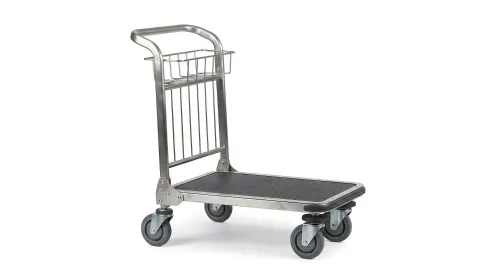
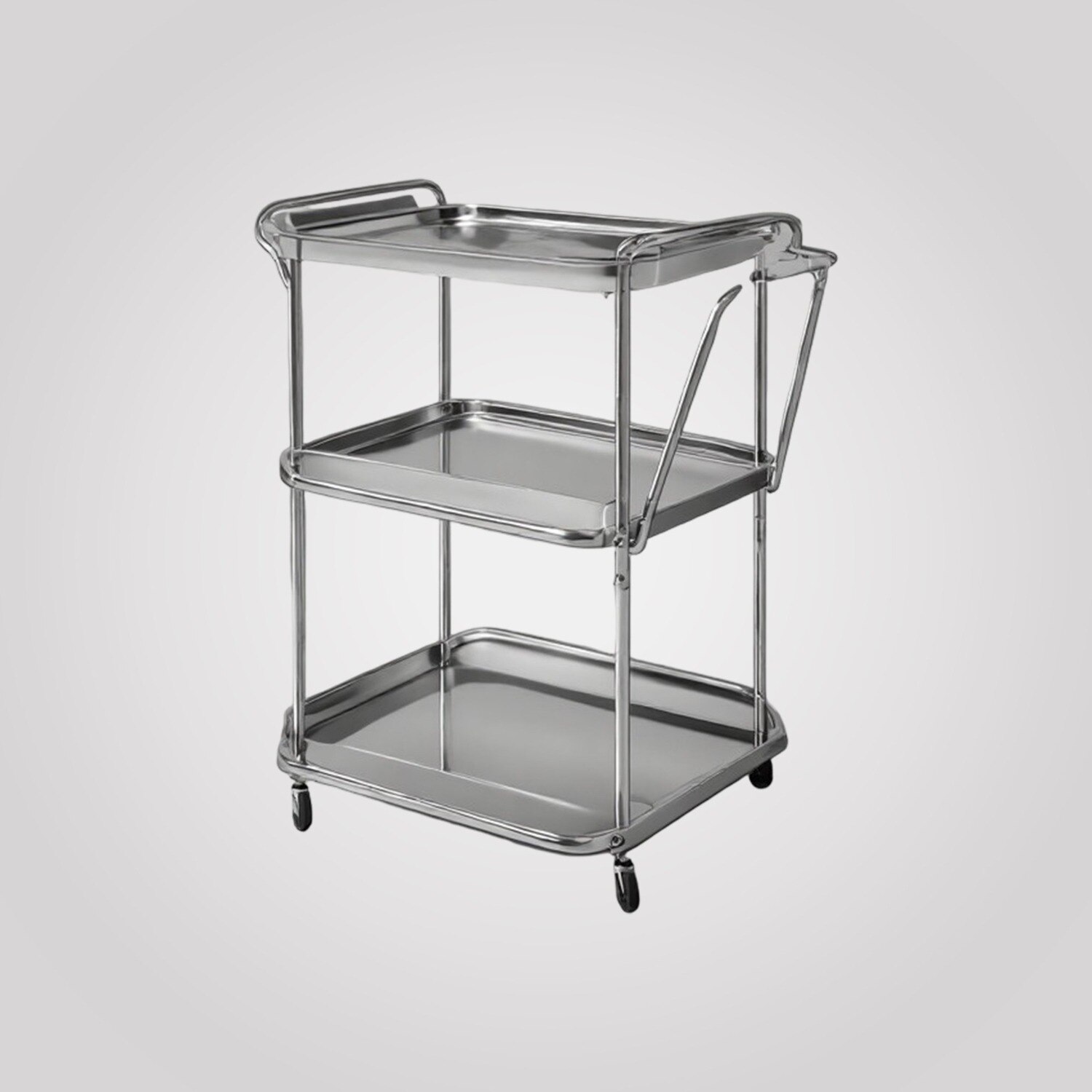
A catering pallet will move safely only when its footprint, weight and retention method match the trolley shelf beneath it. By checking the tray format, loading order, route dimensions and caster specification, you can decide whether an open three-tier trolley suits your operation or whether you need runners, insulation or a different service design.
Key takeaways
- Define the pallet footprint, material, loaded weight and handling format first.
- Keep heavier pallets on the bottom tier to lower the centre of gravity.
- Measure doorways, turns, ramps and lift interiors before ordering the trolley.
- Choose casters for the floor, load and route—not shelf dimensions alone.
Define the Catering Pallet Before Choosing the Trolley
“Catering pallet” can mean a GN tray or container, a banquet service tray, or a transport pallet holding crates. Define the external footprint, material, loaded weight and handling format before choosing a utility trolley for pallets.
An open trolley only transports; it does not hold food hot or cold or shield it from splashes and ambient contamination.
| Format | Common dimensions | Trolley requirement |
|---|---|---|
| GN 1/1 | 530 × 325 mm | Shelf or runners must exceed this footprint |
| GN 2/1 | 650 × 530 mm | Requires a deeper, wider shelf and higher load rating |
| GN 1/2 | 325 × 265 mm | Check whether smaller trays need a grid or tray stop |
| Banquet or transport pallet | Measure the actual unit | Do not assume GN compatibility |
Confirm each tier separately, because a frame can narrow the usable opening even when the shelf looks large:
- Measure the pallet’s loaded width and depth, then compare them with the clear shelf dimensions, not the trolley’s outside dimensions.
- Check shelf pitch against the pallet height, including its lid, handle or crate rim.
- Confirm whether it sits directly on the shelf, slides into runners, or needs a retaining lip or rail.
- Test the loaded pallet on every tier for overhang, shifting and contact with the frame.
This is the practical answer to how a three-tier utility trolley works with catering pallets in Mumbai: specify the actual pallet, route load and restraint method, not merely “three-tier.”
Follow a One-Way Restaurant Utility Trolley Workflow
A loaded catering pallet should move in one direction: receiving, clean staging, service, collection, then wash-up or storage. That restaurant utility trolley workflow keeps filled food containers and clean serviceware away from returned dirty ware instead of sending both through the same open shelf.
- At receiving, check the pallet’s external dimensions, load limit and tray or crate format against the trolley’s usable shelf opening. Reject a pallet that overhangs, exceeds the shelf rating or cannot sit securely.
- Load dense, stable items on the bottom tier, the main service load on the middle tier and light items needed first on the top tier. Push each pallet against a lip, tray stop, retaining rail or removable grid.
- Move the loaded trolley to a clean staging point, keeping handles, aisle space and sightlines clear. Apply the brake while staff unload or arrange service items.
- During service, remove clean pallets in delivery order rather than reaching across higher loads. Keep the trolley on its planned route.
- Place used trays, plates and containers in a designated return pallet or separate return trolley. Do not mix them with unused serviceware.
- Return the dirty load directly to wash-up, then clean and inspect shelves, stops and casters before storage.
Load Three Tiers Without Creating an Unstable Stack
Put the heaviest catering pallet on the lowest tier, with lighter loads above it and the centre of each pallet close to the shelf centre. Keep liquid containers upright and do not place an offset load at one end; a high or eccentric centre of gravity can make the trolley tip during a turn.
Use this loading check for every trolley:
- Record each shelf’s usable length, width and clear height, excluding lips, posts and handles.
- Confirm the pallet fits inside those dimensions without overhanging, then weigh the pallet and its contents.
- Compare that weight with the shelf’s uniformly distributed load rating and the manufacturer’s reduced rating for mobile use.
- Add the trolley tare weight and all pallet weights; use the complete trolley’s mobile rating, not the sum of three shelf ratings.
- Confirm castor capacity for movement over thresholds, uneven floors and uneven loads. Do not divide the static total by four; one castor can carry much more than one quarter during movement.
A pallet should sit on a shelf, removable grid or dedicated runners that support its base evenly. Fit a raised lip, tray stop or retaining rail sized to the pallet, and test a fully loaded trolley with gentle starts, stops and turns.
If the pallet slides, do not rely on speed reduction alone; add positive retention or reduce the load. Keep clean filled pallets separate from returned dirty ones.
Measure the Route, Not Just the Shelf
A trolley that fits the shelf can still fail at the first fire door. Measure the fully loaded unit, including pallet overhang, handles, push bars and any retaining rail; record its overall width, depth, height and total weight.
Check each narrow or changing point on the actual route:
- Measure the narrowest clear door opening, not the frame size.
- Record lift-car width, depth, door opening and internal height; mark the turning space needed to enter, rotate and exit.
- Measure corridor width at corners, beside parked equipment and near service counters.
- Record every ramp gradient, threshold height and floor joint.
- Check the final approach to staging, kitchen pass, wash-up and storage areas.
| Checkpoint | Measure on the trolley | Measure in the building |
|---|---|---|
| Door passage | Loaded width and height | Narrowest clear opening and overhead obstruction |
| Lift travel | Loaded weight and turning footprint | Car floor, door opening and usable height |
| Ramp or threshold | Caster clearance and ground clearance | Rise, edge shape and available landing |
| Service area | Depth including handle swing | Turning space beside counters, walls and doors |
A two-centimetre threshold can stop small casters or shift liquid-filled containers. Test with the heaviest normal load, and include doors held open only if staff can hold them safely without blocking the route.
Match Casters and Handling Rules to the Floor
Choose non-marking polyurethane casters with ball bearings, enough diameter to roll over the measured threshold, and a rated capacity based on movement rather than static load divided by four. A four-caster trolley does not share weight evenly when a pallet shifts or one wheel crosses a joint.
| Floor condition | Caster and control choice | Operating rule |
|---|---|---|
| Smooth floor | Swivel casters with low rolling resistance and positive brakes | Push with both hands; avoid sharp turns at speed |
| Thresholds | Larger-diameter casters with sealed bearings and a tray lip or retaining rail | Approach squarely, slow down, and lift or steady the load across the step |
| Ramps | Swivelling casters with brakes on more than one wheel and a rigid frame | Keep the trolley aligned with the slope; use a second operator when the loaded unit cannot be stopped safely |
Apply every brake before placing trays on a shelf, removing them, or parking beside a service counter. One locked wheel does not stabilise a trolley on a wet or sloping floor.
- Push rather than pull so you can see the route and keep the load ahead of your body.
- Reduce speed before door thresholds, expansion joints and lift entries; do not cross them diagonally.
- Keep heavy items on the lowest tier and never turn a loaded trolley across a ramp.
- Stop if a caster chatters, drifts or lifts; unload the trolley before inspecting it.
Turn the Specification Into a Mumbai Purchase Check
Ask a supplier to confirm these points in writing before ordering a three tier utility trolley in mumbai:
- The clear shelf length, width, height and load rating for each tier; compare them with the catering pallet’s external dimensions and weight.
- Whether pallets sit on flat shelves, need GN runners, or require a removable grid, tray stop, raised lip or retaining rail. “Three tier” does not confirm GN compatibility.
- The brake arrangement: positive wheel brakes on how many casters, and whether the trolley stays fixed on a wet or sloping floor during loading.
- Cleaning access around welded corners, shelf undersides, caster plates and drains. Ask whether shelves or runners remove without tools and which stainless-steel surfaces contact food.
- The cleaning and separation plan for clean filled containers versus returned dirty ware. An open trolley is not a hot-holding or cold-holding appliance.
Ambica Sales & Services can help you test these points against the actual route and pallet format rather than relying on a catalogue name.
| Option | What it means | When it applies |
|---|---|---|
| Three-tier utility trolley | Open platforms for mixed loads; flexible, but trays can shift | Boxes, plates and general transport |
| Commercial service trolley | May add enclosed sides, drawers, tray slides or waste compartments | Meal service, segregation or protected handling |
| GN-rack trolley | Runners locate gastronorm containers | Multiple liquid-filled or hot GN containers |
Related products
 | Service Equipment Utility Trolley 3 Tier View product → |
 | Trolleys Service Trolley - 3 Tier View product → |
Frequently asked questions
What should you define before choosing a trolley for catering pallets?
Record whether the pallet is a GN container, banquet tray or crate transport pallet, then measure its external footprint, material, loaded weight and handling format.
How should a three-tier utility trolley fit a restaurant workflow?
Use a one-way route from loading to service to return, keeping clean and dirty movement separate and preventing unnecessary crossings.
How do you load three trolley tiers safely?
Place the heaviest pallet on the lowest tier, centre each load, keep weight within the trolley rating and secure items that can slide or overhang.
What should you measure before buying a utility trolley for pallets?
Measure shelf clearance, doorways, corridor width, turning space, ramps, lift interiors and the trolley’s total width, depth and height.
How do you choose casters for a commercial service trolley?
Match caster diameter, brakes, swivel action and load rating to the floor surface, thresholds, slopes and the route’s handling demands.
Keywords